
Crossroads News : Changes In The World Around Us And Our Place In It
World’s biggest geoengineering experiment ‘violates’ UN rules
Controversial US businessman’s iron fertilisation off west coast of Canada contravenes two UN conventions
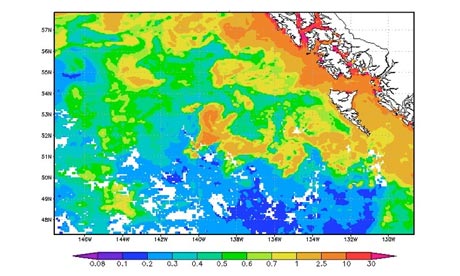
A controversial American businessman dumped around 100 tonnes of iron sulphate into the Pacific Ocean as part of a geoengineering scheme off the west coast of Canada in July, a Guardian investigation can reveal.
Lawyers, environmentalists and civil society groups are calling it a “blatant violation” of two international moratoria and the news is likely to spark outrage at a United Nations environmental summit taking place in India this week.
Satellite images appear to confirm the claim by Californian Russ George that the iron has spawned an artificial plankton bloom as large as 10,000 square kilometres. The intention is for the plankton to absorb carbon dioxide and then sink to the ocean bed – a geoengineering technique known as ocean fertilisation that he hopes will net lucrative carbon credits.
George is the former chief executive of Planktos Inc, whose previous failed efforts to conduct large-scale commercial dumps near the Galapagos and Canary Islands led to his vessels being barred from ports by the Spanish and Ecuadorean governments. The US Environmental Protection Agency warned him that flying a US flag for his Galapagos project would violate US laws, and his activities are credited in part to the passing of international moratoria at the United Nations limiting ocean fertilisation experiments
Scientists are debating whether iron fertilisation can lock carbon into the deep ocean over the long term, and have raised concerns that it can irreparably harm ocean ecosystems, produce toxic tides and lifeless waters, and worsen ocean acidification and global warming.
“It is difficult if not impossible to detect and describe important effects that we know might occur months or years later,” said John Cullen , an oceanographer at Dalhousie University. “Some possible effects, such as deep-water oxygen depletion and alteration of distant food webs, should rule out ocean manipulation. History is full of examples of ecological manipulations that backfired.”
Update 10/22/12
Crossroads News : Changes In The World Around Us And Our Place In It
Canadian government knew about sea fertilizing: organizers
by Staff Writers
Vancouver (AFP)

|
Organizers of a controversial ocean fertilization project off Canada’s west coast said Friday officials knew of the undertaking but did not stop it, and that it violated no laws.
The project, carried out by a small aboriginal village together with US businessman Russ George, involved used a fishing boat to scatter 120 tonnes of iron sulphate last August into the Pacific Ocean west of Haida Gwaii, an archipelago off British Columbia.
The move was criticized by environmentalists, aboriginal groups and scientists for violating an international ban on ocean fertilization. It was even cited at this week’s meeting of the United Nations Convention on Biological Diversity in Hyderabad, India.
The government has denied any involvement and on Thursday a spokesman for Environment Minister Peter Kent said an investigation into the matter had been launched on August 30.
Adam Sweet told AFP federal officials met project organizers last May and told them “any iron ore deposit in waters, whether inside or outside the Canadian (200 nautical miles) limit, constitutes a violation of the Canadian Environmental Protection Act,” unless it is for the purpose of legitimate research.
One of the organizers, John Disney of the Village of Old Massett, insisted organizers followed international legal and scientific protocols, and that at least seven Canadian federal agencies knew of their plan.
“The government knew exactly what we were doing,” Disney told a news conference at the Vancouver Aquarium. “The work was performed in international waters, and is lawful.”
Organizers said the project aims to test two goals:
One is whether iron dust can boost the ocean ecosystem and increase the struggling population of salmon, a mainstay of the area’s culture and economy.
The other is whether iron dust will increase plankton, a species at the base of the ocean food chain, and lead to future profit through the sale of carbon credits.

Comments
Thank you DesertRose. I felt that I had offended you. Lately, I have a hard time with my emotions. They are too strong most of the time and I seem to hurt people without knowing. Yes when I read your article posted above, I was surprised that no mentions were made about the agreement between Mr. George and the Haida First Nation. Thank you for digging. You always post very good articles. Keep them coming.
Oh no Rosemary, I did not perceive you as being harsh at all , dear.
I just found it strange that there was no mention of First Nation so I went looking ,lol
I welcome interaction and if there is something else that needs to be investigated I am more than happy to start digging :)
No worries dear one . I simply wanted you to know that I had found the reference to First Nation as it was because of you that I went looking. That was all all is good :)
My apology Desert I did not mean to sound harsh. I have read the update and it i found this strange that the Canadian Government did not react to the project knowing full well that it was going to be carried out. CBC news did not mentioned Mr. Russ George, but dwell more a scientist who had been refused this experiment because it was controversial. I agree with you that Mr. George may have taken advantage of the Haida First Nation. They are a very strong will group who have succeeded in self government. Only time will tell if this experiment was a real success.
This update is for you Rosemary :)
I am not disputing what you say Rosemary as I am not privy to Canada news to the extent you are .
I find it strange though............So then why does Russ George state he was doing this in hopes of the carbon credits? He may have taken advantage of the desire First Nation had to do something about the salmon. However that does not mean his intentions were the same. He could very well have taken advantage of the situation. It would not be the first time it happened. It is clear he was looking for monetary benefits.
Well the Canadian version is rather different. According to the Haida Guai First Nation, this experiment was carried out because of the dwindling salmon population of the coast of the archipelago. It is a known scientific fact that salmons trive in plankton rich water. Since salmon have decrease in numbers, the decision to allow this experiments was based on the need of the population to have an increase return of the salmon to feed their population. It is true that this decision was taken without any other environmental investigation, but like all First Nation around the world, there right to self govern is proportional to what mega company that comes barging in their territory want to do with First Nation natural resources. There is a lot of chemical that are dump into the ocean that we do not know anything about. Case in point: there is a man made island in the Pacific ocean that is quite large and thick. It is the results of ocean dumping of waste. It kills more fish than fishing itself. When the plastic disintegrate, small plastic balls fall in the bottom of the ocean. Bottom feeders actually ingest there balls and become sick.