All Posts (15455)

Sort by

Solar Activity & Space

Earth Watch Report – Sunday August 26th, 2012


Solar Activity

3MIN News August 25. 2012

Published on Aug 25, 2012 by Suspicious0bservers

Spaceweather: http://spaceweather.com/[Look on the left at the X-ray Flux and Solar Wind Speed/Density]

HAARP: http://www.haarp.alaska.edu/haarp/data.html[Click online data, and have a little fun]

SDO: http://sdo.gsfc.nasa.gov/data/[Place to find Solar Images and Videos - as seen from earth]

SOHO: http://sohodata.nascom.nasa.gov/cgi-bin/soho_movie_theater[SOHO; Lasco and EIT - as seen from earth]

Stereo: http://stereo.gsfc.nasa.gov/cgi-bin/images[Stereo; Cor, EUVI, HI - as seen from the side]

SunAEON:http://www.sunaeon.com/#/solarsystem/[Just click it... trust me]

SOLARIMG: http://solarimg.org/artis/[All purpose data viewing site]

iSWA: http://iswa.gsfc.nasa.gov/iswa/iSWA.html[Free Application; for advanced sun watchers]

NASA ENLIL SPIRAL: http://iswa.gsfc.nasa.gov:8080/IswaSystemWebApp/iSWACygnetStreamer?timestamp=…
NOAA ENLIL SPIRAL: http://www.swpc.noaa.gov/wsa-enlil/

NOAA Bouys: http://www.ndbc.noaa.gov/

RSOE: http://hisz.rsoe.hu/alertmap/index2.php[That cool alert map I use]

JAPAN Radiation Map: http://jciv.iidj.net/map/

LISS: http://earthquake.usgs.gov/monitoring/operations/heliplots_gsn.php

Gamma Ray Bursts: http://grb.sonoma.edu/[Really? You can't figure out what this one is for?]

BARTOL Cosmic Rays: http://neutronm.bartol.udel.edu//spaceweather/welcome.html[Top left box, look for BIG blue circles]

TORCON: http://www.weather.com/news/tornado-torcon-index[Tornado Forecast for the day]

GOES Weather: http://rsd.gsfc.nasa.gov/goes/[Clouds over America]

EL DORADO WORLD WEATHER MAP: http://www.eldoradocountyweather.com/satellite/ssec/world/world-composite-ir-…

PRESSURE MAP: http://www.woweather.com/cgi-bin/expertcharts?LANG=us&MENU=0000000000&…

HURRICANE TRACKER: http://www.weather.com/weather/hurricanecentral/tracker

INTELLICAST: http://www.intellicast.com/[Weather site used by many youtubers]

NASA News: http://science.nasa.gov/science-news/science-at-nasa/

Space


 Earth approaching objects (objects that are known in the next 30 days)

Object Name Apporach Date Left AU Distance LD Distance Estimated Diameter* Relative Velocity
(2009 AV) 26th August 2012 0 day(s) 0.1615 62.8 670 m – 1.5 km 22.51 km/s 81036 km/h
331769 (2003 BQ35) 28th August 2012 2 day(s) 0.1585 61.7 240 m – 530 m 4.64 km/s 16704 km/h
(2010 SC) 28th August 2012 2 day(s) 0.1679 65.3 16 m – 36 m 9.56 km/s 34416 km/h
4769 Castalia 28th August 2012 2 day(s) 0.1135 44.2 1.4 km 12.06 km/s 43416 km/h
(2012 LU7) 02nd September 2012 7 day(s) 0.1200 46.7 440 m – 990 m 8.16 km/s 29376 km/h
(2012 FS35) 02nd September 2012 7 day(s) 0.1545 60.1 2.3 m – 5.2 m 2.87 km/s 10332 km/h
(2012 HG31) 03rd September 2012 8 day(s) 0.0716 27.9 440 m – 990 m 10.33 km/s 37188 km/h
(2012 PX) 04th September 2012 9 day(s) 0.0452 17.6 61 m – 140 m 9.94 km/s 35784 km/h
(2012 EH5) 05th September 2012 10 day(s) 0.1613 62.8 38 m – 84 m 9.75 km/s 35100 km/h
(2011 EO11) 05th September 2012 10 day(s) 0.1034 40.2 9.0 m – 20 m 8.81 km/s 31716 km/h
(2007 PS25) 06th September 2012 11 day(s) 0.0497 19.3 23 m – 52 m 8.50 km/s 30600 km/h
329520 (2002 SV) 08th September 2012 13 day(s) 0.1076 41.9 300 m – 670 m 9.17 km/s 33012 km/h
(2011 ES4) 10th September 2012 15 day(s) 0.1792 69.8 20 m – 44 m 12.96 km/s 46656 km/h
(2008 CO) 11th September 2012 16 day(s) 0.1847 71.9 74 m – 160 m 4.10 km/s 14760 km/h
(2007 PB8) 14th September 2012 19 day(s) 0.1682 65.5 150 m – 340 m 14.51 km/s 52236 km/h
226514 (2003 UX34) 14th September 2012 19 day(s) 0.1882 73.2 260 m – 590 m 25.74 km/s 92664 km/h
(1998 QC1) 14th September 2012 19 day(s) 0.1642 63.9 310 m – 700 m 17.11 km/s 61596 km/h
(2002 EM6) 15th September 2012 20 day(s) 0.1833 71.3 270 m – 590 m 18.56 km/s 66816 km/h
(2002 RP137) 16th September 2012 21 day(s) 0.1624 63.2 67 m – 150 m 7.31 km/s 26316 km/h
(2009 RX4) 16th September 2012 21 day(s) 0.1701 66.2 15 m – 35 m 8.35 km/s 30060 km/h
(2005 UC) 17th September 2012 22 day(s) 0.1992 77.5 280 m – 640 m 7.55 km/s 27180 km/h
(2012 FC71) 18th September 2012 23 day(s) 0.1074 41.8 24 m – 53 m 3.51 km/s 12636 km/h
(1998 FF14) 19th September 2012 24 day(s) 0.0928 36.1 210 m – 480 m 21.40 km/s 77040 km/h
331990 (2005 FD) 19th September 2012 24 day(s) 0.1914 74.5 320 m – 710 m 15.92 km/s 57312 km/h
(2009 SH2) 24th September 2012 29 day(s) 0.1462 56.9 28 m – 62 m 7.52 km/s 27072 km/h
1 AU = ~150 million kilometers,1 LD = Lunar Distance = ~384,000 kilometers Source: NASA-NEO


……………………………………

A quick check of Hubble’s gallery shows just 1,300 images; however more than raw 700,000 images reside in a vast archive with hundreds of potentially jaw-dropping astronomical scenes just waiting to be uncovered. That was the idea behind the European Space Agency’s international contest called Hubble’s Hidden Treasures. And now with the hard work of amateur astronomers and more than 3,000 submissions, some of Hubble’s incredible celestial treasures are revealed.

“The response was impressive, with almost 3000 submissions,” the ESA said in a press release. “More than a thousand of these images were fully processed: a difficult and time-consuming task. We’ve already started featuring the best of these in our Hubble Picture of the Week series.”

The top 10 images selected in the Hubble Hidden Treasures basic imaging category. Top row: NGC 6300 by Brian Campbell, V* PV Cephei by Alexey Romashin, IRAS 14568-6304 by Luca Limatola, NGC 1579 by Kathlyn Smith, B 1608+656 by Adam Kill Bottom row: NGC 4490 by Kathy van Pelt, NGC 6153 by Ralf Schoofs, NGC 6153 by Matej Novak, NGC 7814 by Gavrila Alexandru, NGC 7026 by Linda Morgan-O’Connor

Credit: NASA & ESA

Judges ranked images from two categories, an image processing category and basic image searching category. Judges sifted through 1189 entries in the image processing category; a painstaking process of finding promising data and creating an attractive image using professional imaging software. But even if contestants didn’t have the technical know-how to create large mosaics and combine color filters, they could find stunning images in the Hubble archive using using simple online tools. The ESA received more than 1600 entries in this category.

“Every week, we search the archive for hidden treasures, process the scientific data into attractive images and publish them as the Hubble Picture of the Week,” says the ESA on their Hidden Treasures website. “But the archive is so vast that nobody really knows the full extent of what Hubble has observed.”
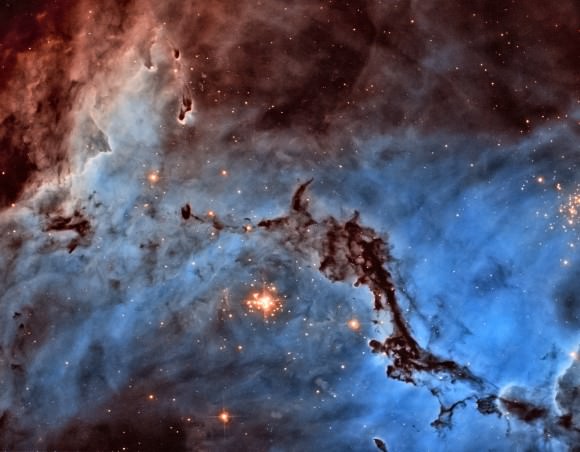
Josh Lake of the United States won with this awesome image of NGC 1763, part of the N11 star-forming region of the Large Magellanic Cloud.

First place in the processed category, which asked contestants to find promising data within the archive and process that scene into an attractive image, went to Josh Lake, from the United States. The image, which won the public vote, narrowly edged out other images. Lake produced a bold two-color image that is not in natural colors but contrasts light from glowing hydrogen and nitrogen. In natural colors, the two glowing gasses produce almost indistinguishable shades of red. Lake’s image separates them out into red and blue offering a dramatic view of the structure.

Messier 77 produced by Andre van der Hoeven, of the Netherlands came in a close second.

Andre van der Hoeven of the Netherlands came in a close second. The jury noted the impressive nature of Messier 77 in the image as well as the processing which combines several datasets from separate instruments to create the amazing image.

“This was my hardest job until now,” van der Hoeven says on the Flickr page. “Combining the different datasets to get equal colors was really hard. M77 was not fully covered by one dataset, so I had to combine channels of the WFPC2 with different wavelengths and tune the colors to get them to fit. But the result is in my opinion quite astonishing.”

We are as surprised as him that this image had not been released before.

Judy Schmidt of the United States entered this image of XZ Tauri, a new star lighting up a nearby cloud of gas and dust. She entered several images into the contest.

Third place went to an interesting image of XZ Tauri, a newborn star spraying gas into its surroundings as well as lighting up a nearby cloud of gas. The panel said it was a challenging dataset to process because Hubble captured only two colors in the region. “Nevertheless, the end result is an attractive image, and an unusual object that we would never have found without her help,” the panel said.

Revealing the challenge of many Hubble mosaics, the jury was impressed with the technical achievement Renaud Houdinet showed in putting together this ambitious view. He called this “The Great Mosaic Disaster in Chamaeleon. “Sometimes, things don’t turn out as they ought,” Houdinet admits on the Flickr description. Chamaeleon 1 is a large nebula near the south celestial pole and was not covered in one single Hubble image.

Robert Gendler took fifth place with an image of spiral galaxy Messier 96. You may know Gendler’s work as his version of Hubble’s image of NGC 3190 is the default image on the desktop of new Apple computers.

Top image caption: Top ten images selected in the Hubble Hidden Treasures image processing competition. Top row: NGC 1763 by Josh Lake, M 77 by Andre van der Hoeven, XZ Tauri by Judy Schmidt, Chamaeleon I by Renaud Houdinet, M 96 by Robert Gendler. Bottom row: SNR 0519-69 by Claude Cornen, PK 111-2.1 by Josh Barrington, NGC 1501 by kyokugaisha1, Abell 68 by Nick Rose, IC 10 by Nikolaus Sulzenauer. Credit: NASA & ESA

Links:

About the Author: John Williams is owner of TerraZoom, a Colorado-based web development shop specializing in web mapping and online image zooms. He also writes the award-winning blog, StarryCritters, an interactive site devoted to looking at images from NASA’s Great Observatories and other sources in a different way. A former contributing editor for Final Frontier, his work has appeared in the Planetary Society Blog, Air & Space Smithsonian, Astronomy, Earth, MX Developer’s Journal, The Kansas City Star and many other newspapers and magazines.

Read more…

Epidemic Hazards / Diseases & Climate Change

Earth Watch Report – Sunday August 26th, 2012

Epidemic Hazards / Diseases


25.08.2012 Epidemic Hazard Nepal Khimna VDC, Palanta [Kalikot District] Damage level Details


Epidemic Hazard in Nepal on Saturday, 25 August, 2012 at 14:11 (02:11 PM) UTC.

Description
Four school girls have died from an unknown disease at Khimna VDC in Palanta area of Kalikot district. Over 65 students have fallen sick due to a breakout of mysterious disease. The victims were the students at the local Kalika Lower Secondary School. Following an outbreak of mysterious illness, an emergency meeting of the school management on last Wednesday decided to close the school until the situation comes under control, said school principal Man Bahadur Budha. Principal Budha has complained that the District Public Health Office has turned a deaf ear towards frequent calls by the school management to take measures to investigate the causes of mass illness and take the situation under control. “The local health centers here are not able to provide even Citamol tablets for the sick,” he said. The locals have submitted an application at the District Administration Office and the District Education Office demanding that lives of the students be saved. Meanwhile, a man who, was found dead on the bank of a glacier at Phoimahadev Ward No-1 in the district few days back, has been identified, said the District Police Office, Jumla. He is Surya Hamal, 29, of Narakot-2 in the district. Mentally ill Hamal had left his home some two weeks ago, said the family source. His body was handed to the family today and his final rites were conducted today itself.
Biohazard name: Unidentified fatal disease
Biohazard level: 4/4 Hazardous
Biohazard desc.: Viruses and bacteria that cause severe to fatal disease in humans, and for which vaccines or other treatments are not available, such as Bolivian and Argentine hemorrhagic fevers, H5N1(bird flu), Dengue hemorrhagic fever, Marburg virus, Ebola virus, hantaviruses, Lassa fever, Crimean-Congo hemorrhagic fever, and other hemorrhagic or unidentified diseases. When dealing with biological hazards at this level the use of a Hazmat suit and a self-contained oxygen supply is mandatory. The entrance and exit of a Level Four biolab will contain multiple showers, a vacuum room, an ultraviolet light room, autonomous detection system, and other safety precautions designed to destroy all traces of the biohazard. Multiple airlocks are employed and are electronically secured to prevent both doors opening at the same time. All air and water service going to and coming from a Biosafety Level 4 (P4) lab will undergo similar decontamination procedures to eliminate the possibility of an accidental release.
Symptoms:
Status: suspected


………………………………………..

New Strain of Hand, Foot and Mouth Virus Worries Parents, Pediatricians


ScienceDaily


Your child goes to bed in perfect health. The next morning she wakes up with high fever, malaise and bright red blisters erupting all over her body. Johns Hopkins Children’s Center dermatologists say the disturbing scenario has become quite common in the last few months, sending scared parents to their pediatrician’s office or straight to the emergency room.


Bernard Cohen, M.D., director of pediatric dermatology at Johns Hopkins Children’s Center, and colleague Kate Puttgen, M.D., have seen or consulted on close to 50 such cases in the last few months and have received countless phone calls from scared parents and concerned physicians. Cohen believes this number may be just the tip of the iceberg with primary care pediatricians seeing the bulk of new cases.

Cohen and Puttgen want to reassure parents that most cases of the disease are benign and that nearly all patients recover in seven to 10 days without treatment and without serious complications.

“What we are seeing is relatively common viral illness called hand-foot-and-mouth disease but with a new twist,” Cohen says.

The culprit is an unusual strain of the common coxsackie virus that usually causes the disease. The new strain, coxsackie A6, previously found only in Africa and Asia, is now cropping up all over the United States.

The coxsackie virus strikes infants and children under age 5 in the summer and autumn months. Symptoms include fever and malaise and, a day or two later, a non-itchy skin rash with flat or raised red spots on the hands and feet and/or mouth sores. The new strain, however, behaves somewhat differently from its homegrown cousin, Cohen says. It carries a slightly higher risk for more serious illness and more widespread rash that can involve the arms, legs, face and diaper area. The new strain also seems to affect older as well as younger children.

“We’ve talked with many of our pediatric dermatology colleagues around the country and the number of cases and the severity of the rash is clearly new and different from the typical hand, foot and mouth disease we are used to seeing,” adds Puttgen. “The good news is that it looks bad but hasn’t actually caused severe symptoms for our patients.”

The new virus can also cause a rash that mimics lesions of herpes simplex virus, which requires treatment with antivirals.

“It can look like disseminated herpes simplex, and parents may panic if they don’t know what it is,” Cohen says. “But unlike herpes simplex, this rash evolves very fast. It’s bad for a few days and then gets better very quickly without any treatment at all.”

To reduce the spread of the virus, Cohen and Puttgen advise frequent hand washing and good general hygiene. Pediatricians need not refer patients to a specialist if they recognize the rash for what it is and if the child is otherwise healthy, they say. “If the child has low-grade fever, but is otherwise well, waiting and watching is appropriate,” Cohen says. “If the child is having problems with feeding or drinking or acting ill, it’s time to call the doctor.” Specifically, Cohen says, children with immune deficiencies, cancer or other serious illness should be followed closely by their pediatrician to avoid or promptly treat any complications.

************************************************************************************************************

Climate Change


Good News from the Bad Drought: Gulf ‘Dead Zone’ Smallest in Years


ScienceDaily


The worst drought to hit the United States in at least 50 years does have one benefit: it has created the smallest “dead zone” in the Gulf of Mexico in years, says a Texas A&M University researcher who has just returned from gulf waters.


Less oxygen dissolved in the water is often referred to as a “dead zone” (in red above) because most marine life either dies, or, if they are mobile such as fish, leave the area. Habitats that would normally be teeming with life become, essentially, biological deserts. (Credit: NOAA)

Oceanography professor Steve DiMarco, one of the world’s leading authorities on the dead zone, says he and other Texas A&M researchers and graduate students analyzed the Gulf Aug. 15-21 and covered more than 1,200 miles of cruise track, from Texas to Louisiana. The team found no hypoxia off the Texas coast while only finding hypoxia near the Mississippi River delta on the Louisiana coast.

“We had to really hunt to find any hypoxia at all and Texas had none,” he explains.

“The most severe hypoxia levels were found near Terrabonne Bay and Barataria Bay off the coast of southeast Louisiana.

“In all, we found about 1,580 square miles of hypoxia compared to about 3,400 square miles in August 2011. What has happened is that the drought has caused very little fresh-water runoff and nutrient load into the Gulf, and that means a smaller region for marine life to be impacted.”

DiMarco has made 27 research trips to investigate the dead zone since 2003.

DiMarco says the size of the dead zone off coastal Louisiana has been routinely monitored for about 25 years. Previous research has also shown that nitrogen levels in the Gulf related to human activities have tripled over the past 50 years. During the past five years, the dead zone has averaged about 5,700 square miles and has reached as high as 9,400 square miles.

Hypoxia is when oxygen levels in seawater drop to dangerously low levels, defined as concentrations less than 2 milligrams per liter, and persistent hypoxia can potentially result in fish kills and harm marine life, thereby creating a “dead zone” of life in that particular area.

The Mississippi is the largest river in the United States, draining 40 percent of the land area of the country. It also accounts for almost 90 percent of the freshwater runoff into the Gulf of Mexico.

“These findings confirm what we found in a trip to the Gulf back in June, and also what other researchers in Louisiana have discovered, so there is general agreement that the dead zone this year is a very, very small one.

“But the situation could certainly change by next spring,” DiMarco adds.

“The changes we see year to year are extreme. For example, last year, record flooding of the Mississippi River and westerly winds in the Gulf led to a much larger hypoxic area, particularly earlier in the summer. We’ll just have to wait and see what kind of rainfall is in store for the Midwest over the next 8-10 months.”


Read more…

Earth Watch Report – Sunday August 26th, 2012

Extreme Temperatures/ Weather

Bosnia on red alert during hottest summer on record

by Staff Writers
Sarajevo (AFP)

Bosnian authorities put the entire country on red alert Thursday against a heatwave that has seen the Balkan nation bake in its hottest summer on record, the national weather institute said.

Meteorologist Dzenan Zulum said the months of June, July and August had been the hottest since measurements were first recorded 120 years ago.

In some places, the mercury has soared to 41 degrees Celsius (105.8 Fahrenheit) and temperatures in the capital Sarajevo have in recent days been about seven degrees Celsius warmer than normal.

“We predict a similar temperature for the next two or three days followed by a slight cooling from Sunday,” Zulum said.

Farmers say between 50-80 percent of their crops have been damaged in the heatwave, and water distribution to several towns has been disrupted.

Bosnia is also battling dozens of forest fires in the south and east of the country, with many hundreds of hectares (acres) of land burned.

Related Links
Weather News at TerraDaily.com


25.08.2012 Forest / Wild Fire Greece Region of Attica, [Near to Afidnes] Damage level Details


Forest / Wild Fire in Greece on Saturday, 25 August, 2012 at 13:08 (01:08 PM) UTC.

Description
Firefighters on Saturday managed to partially control a large forest fire that broke out on the northeastern outskirts of Athens, officials said. “I believe we are going well,” Pavlos Papageorgiou, a senior fire department officer, told state television NET. “The only front is in a ravine near the town of Afidnes, we are moving forces from other areas where the fire is under control,” he said. The fire broke out before dawn near Afidnes, clouding the skies over the capital’s northern suburbs with smoke and ash. It had earlier threatened an army camp and an industrial park in the vicinity. NET said a number of homes and vehicles had been burnt in the community of Drosopigi and that local residents had heard explosions before the fire broke out, suggesting that arson was involved. Traffic police briefly diverted traffic on the national highway leading north of Athens as a precaution. The same area had also been ravaged by fires in 2009. Greece suffers from a large number of summer fires usually aided by high temperatures and strong winds and are often attributed to arson. The Athens national observatory this week said the months of June and July were among the hottest on record. The worst disaster this season occurred on the Aegean island of Chios where scores of mastic orchards were destroyed by a fire burning for a week.


***********************************************************************************************************

Storms / Flooding


 Active tropical storm system(s)
Name of storm system Location Formed Last update Last category Course Wind Speed Gust Wave Source Details
Tembin (15W) Pacific Ocean 19.08.2012 26.08.2012 Typhoon III 155 ° 157 km/h 194 km/h 4.27 m JTWC Details


Tropical Storm data

Share:
Storm name: Tembin (15W)
Area: Pacific Ocean
Start up location: N 17° 42.000, E 124° 36.000
Start up: 19th August 2012
Status: Active
Track long: 551.01 km
Top category.:
Report by: JTWC
Useful links:
Past track
Date Time Position Speed
km/h
Wind
km/h
Gust
km/h
Category Course Wave Pressure Source
19th Aug 2012 05:28:29 N 17° 42.000, E 124° 36.000 9 56 74 Tropical Depression 190 11 JTWC
20th Aug 2012 05:16:05 N 18° 0.000, E 124° 48.000 6 139 167 Typhoon I. 360 9 JTWC
21st Aug 2012 04:48:23 N 20° 12.000, E 125° 18.000 13 213 259 Typhoon IV. 360 15 JTWC
23rd Aug 2012 04:49:56 N 22° 30.000, E 123° 36.000 4 204 232 Typhoon III. 270 9 JTWC
24th Aug 2012 05:23:44 N 22° 6.000, E 120° 30.000 19 185 232 Typhoon III. 245 19 JTWC
25th Aug 2012 05:19:01 N 22° 24.000, E 118° 6.000 13 139 167 Typhoon I. 260 17 JTWC
Current position
Date Time Position Speed
km/h
Wind
km/h
Gust
km/h
Category Course Wave
feet
Pressure Source
26th Aug 2012 05:24:20 N 21° 0.000, E 116° 54.000 7 157 194 Typhoon III 155 ° 14 JTWC
Forecast track
Date Time Position Category Wind
km/h
Gust
km/h
Source
27th Aug 2012 12:00:00 N 21° 24.000, E 119° 42.000 Typhoon IV 176 213 JTWC
27th Aug 2012 00:00:00 N 20° 36.000, E 118° 24.000 Typhoon IV 185 232 JTWC
28th Aug 2012 00:00:00 N 22° 48.000, E 120° 54.000 Typhoon II 130 157 JTWC
29th Aug 2012 00:00:00 N 26° 36.000, E 122° 18.000 Typhoon I 102 130 JTWC
30th Aug 2012 00:00:00 N 30° 18.000, E 121° 36.000 Tropical Depression 83 102 JTWC
31st Aug 2012 00:00:00 N 34° 12.000, E 120° 0.000 Tropical Depression 65 83 JTWC


Bolaven (16W) Pacific Ocean 20.08.2012 26.08.2012 SuperTyphoon 315 ° 213 km/h 259 km/h 5.79 m JTWC Details


Tropical Storm data

Share:
Storm name: Bolaven (16W)
Area: Pacific Ocean
Start up location: N 17° 18.000, E 141° 30.000
Start up: 20th August 2012
Status: Active
Track long: 947.93 km
Top category.:
Report by: JTWC
Useful links:
Past track
Date Time Position Speed
km/h
Wind
km/h
Gust
km/h
Category Course Wave Pressure Source
20th Aug 2012 05:13:46 N 17° 18.000, E 141° 30.000 13 56 74 Tropical Depression 330 12 JTWC
21st Aug 2012 04:47:46 N 18° 12.000, E 140° 30.000 9 93 120 Tropical Storm 295 10 JTWC
23rd Aug 2012 04:49:02 N 19° 42.000, E 135° 36.000 9 167 204 Typhoon II. 280 10 JTWC
24th Aug 2012 05:22:54 N 21° 0.000, E 133° 36.000 11 194 241 Typhoon III. 325 16 JTWC
25th Aug 2012 05:16:28 N 23° 30.000, E 132° 6.000 15 232 278 Typhoon IV. 325 18 JTWC
Current position
Date Time Position Speed
km/h
Wind
km/h
Gust
km/h
Category Course Wave
feet
Pressure Source
26th Aug 2012 05:21:23 N 25° 18.000, E 129° 30.000 17 213 259 SuperTyphoon 315 ° 19 JTWC
Forecast track
Date Time Position Category Wind
km/h
Gust
km/h
Source
27th Aug 2012 12:00:00 N 32° 12.000, E 125° 18.000 Typhoon IV 185 232 JTWC
27th Aug 2012 00:00:00 N 29° 0.000, E 126° 36.000 Typhoon IV 194 241 JTWC
28th Aug 2012 00:00:00 N 36° 6.000, E 125° 0.000 Typhoon III 157 194 JTWC
29th Aug 2012 00:00:00 N 43° 42.000, E 128° 6.000 Tropical Depression 65 83 JTWC
30th Aug 2012 00:00:00 N 50° 30.000, E 136° 18.000 Tropical Depression 56 74 JTWC


Isaac (AL09) Atlantic Ocean 21.08.2012 26.08.2012 Tropical Depression 305 ° 93 km/h 111 km/h 5.79 m NOAA NHC Details


 Tropical Storm data

Share:
Storm name: Isaac (AL09)
Area: Atlantic Ocean
Start up location: N 15° 12.000, W 51° 12.000
Start up: 21st August 2012
Status: Active
Track long: 1,763.96 km
Top category.:
Report by: NOAA NHC
Useful links:
Past track
Date Time Position Speed
km/h
Wind
km/h
Gust
km/h
Category Course Wave Pressure Source
22nd Aug 2012 04:54:04 N 15° 36.000, W 55° 36.000 30 65 83 Tropical Storm 275 16 1006 MB NOAA NHC
23rd Aug 2012 05:06:43 N 15° 48.000, W 63° 0.000 31 74 93 Tropical Storm 270 22 1003 MB NOAA NHC
24th Aug 2012 05:17:31 N 16° 42.000, W 68° 42.000 28 74 93 Tropical Storm 290 19 1001 MB NOAA NHC
25th Aug 2012 05:21:33 N 17° 42.000, W 72° 30.000 22 111 139 Tropical Storm 310 15 990 MB NOAA NHC
Current position
Date Time Position Speed
km/h
Wind
km/h
Gust
km/h
Category Course Wave
feet
Pressure Source
26th Aug 2012 06:01:20 N 22° 6.000, W 77° 12.000 28 93 111 Tropical Depression 305 ° 19 997 MB NOAA NHC
Forecast track
Date Time Position Category Wind
km/h
Gust
km/h
Source
27th Aug 2012 12:00:00 N 25° 48.000, W 83° 42.000 Hurricane II 139 167 NOAA NHC
27th Aug 2012 00:00:00 N 24° 36.000, W 81° 48.000 Hurricane I 120 148 NOAA NHC
28th Aug 2012 00:00:00 N 27° 12.000, W 85° 12.000 Hurricane III 157 194 NOAA NHC
29th Aug 2012 00:00:00 N 29° 30.000, W 86° 30.000 Hurricane III 167 204 NOAA NHC
30th Aug 2012 00:00:00 N 31° 30.000, W 86° 30.000 Tropical Depression 93 111 NOAA NHC
31st Aug 2012 00:00:00 N 34° 0.000, W 86° 0.000 Tropical Depression 46 65 NOAA NHC


…………………………………..

Heavy rain, floods kill 26 in Pakistan: officials

by Staff Writers
Muzaffarabad, Pakistan (AFP)

Flash floods and landslides triggered by heavy rain have killed at least 26 people and destroyed hundreds of houses in northern Pakistan, officials said on Thursday.

Chaudhry Abdul Majeed, the prime minister of Pakistan-administered Kashmir said at least 17 people have been killed and nine others injured in six districts since Monday.

“Some 685 houses and 125 shops have been damaged and roads washed away,” Majeed said, adding that a request has been made to the federal government for financial help.

Irshad Bhatti, a spokesman for the country’s National Disaster Management Authority, said the extent of the damage was still being assessed.

The majority of the deaths in Kashmir came when buildings collapsed due to the rains, and a further nine people died in flooding in the northwestern province of Khyber Pakhtunkhwa, officials said.

Adnan Khan, an official from the Khyber Pakhtunkhwa, said he feared the death toll there could rise.

“Dozens of families have suffered and their houses were destroyed, several people are still missing” Khan told AFP.

Weather officials are predicting heavy rain in the next three days and rescue teams are closely monitoring the situation, Bhatti said.

Floods in Pakistan in the summer of 2011 affected 5.8 million people, with floodwaters killing livestock, destroying crops, homes and infrastructure as the nation struggled to recover from record inundations the previous year.

Related Links
Bringing Order To A World Of Disasters
When the Earth Quakes
A world of storm and tempest


Tropical Storm Isaac hugs Cuba coast, expected to be Cat 2 hurricane in Gulf

Florida’s governor declares a state of emergency as residents and tourists flee Key West. Storm preparations are under way all along the Gulf Coast. NBC’s Thanh Truong reports.

By NBC News and wire services

Updated at 6 p.m. ET: Tropical Storm Isaac was hugging the northern coastline of eastern Cuba on Saturday after claiming at least four lives in Haiti. Isaac should become a Category 1 hurricane on Sunday just as it nears the Florida Keys, the U.S. National Hurricane Center said, and then grow into an even stronger Category 2 storm with 100 mph winds.

Isaac “could be significantly stronger than currently forecast” once it enters the Gulf of Mexico, the center said in an advisory.

It will first sweep past southwest Florida and the Florida Keys, where “hurricane conditions are expected … Sunday,” it said in a separate update.

Isaac is a massive storm, with tropical storm-force winds extending 230 miles from the center. Key West International Airport was halting all flights at 7 p.m. Saturday until the storm had passed.

Tropical Storm Isaac is picking up steam as it barrels through the Caribbean. The Weather Channel’s Mike Seidel reports on the storm’s effects.

In Haiti, a woman and a child in the town of Souvenance were killed in the storm, a local official reported. A woman in the southern coastal city of Jacmel was crushed to death when a tree fell on her house, government officials said.

In the capital Port-au-Prince – where some 350,000 people are still living in tents or shelters after the 2010 Haiti earthquake – a girl, 10, was killed when a wall fell on her.

Power outages and flooding were reported as Isaac moved across the hilly and severely deforested Caribbean country.

“There’s a lot of rain, a lot of wind,” said Magdala Jean-Baptiste, who huddled with her frightened children in their home in the southern coastal city of Jacmel. “We haven’t had any power since the storm started yesterday. We passed the night with no sleep.”

Tropical Storm Isaac lashes the island of Hispaniola, killing at least three people in Haiti, where thousands still live in tents after an earthquake over two years ago. NBC’s Mark Potter reports.

In neighboring Dominican Republic, Isaac felled power and phone lines and left at least a dozen towns cut off by flood waters. The most severe damage was reported along the south coast, including the capital Santo Domingo, where more than half the city was without power.

Cuba prepared by closing beaches and evacuating tourists in vulnerable areas, NBC’s Mary Murray and The Weather Channel’s Mike Seidel reported from Havana. Flights across Cuba were also suspended.

In Baracoa, a city on Cuba’s eastern side, high seas began topping the seawall Friday night, Radio Baracoa reported.

Now with 60-mph winds, Isaac should exit Cuba on Sunday and then move south of the Florida Keys and into the Gulf.

Dieu Nalio Chery / AP

Residents wade through a flooded street in Port-au-Prince, Haiti, on Saturday.

Florida Gov. Rick Scott on Saturday declared a state of emergency to make sure local and state agencies would be ready. Republicans effectively canceled the first day of their national convention in Tampa, on Florida’s central Gulf Coast, deciding to gavel it open on Monday, then immediately recess to some time on Tuesday.

Gulf of Mexico operators began shutting down offshore oil and gas rigs on Friday ahead of the storm.

Follow Isaac’s path with our storm tracker
Live updates and analysis from weather.com

Tampa’s weather forecast includes rain and high winds Sunday night and into Monday, The Weather Channel reported. The winds could gust up to 60 mph.

The Weather Channel’s Bryan Norcross tracks Tropical Storm Isaac’s movement and predictions about where it is headed.

Monday and Tuesday include a risk of tornadoes across south Florida.

Officials were handing out sandbags to residents in the Tampa area, which often floods when heavy rainstorms hit. Sandbags also were being handed out in Homestead, 20 years after Hurricane Andrew devastated the community there. Otherwise, however, convention preparations were moving ahead as usual.

Isaac’s exact path is still unclear, but the hurricane center said models suggest it will make landfall somewhere between the Florida Panhandle and New Orleans on Tuesday night.

The storm’s anticipated path did shift closer to the Keys than previously forecast and emergency managers urged tourists to leave the islands if they could do so safely. A single road links the chain of islands to the Florida Peninsula.

Reuters and The Associated Press contributed to this report.

Walter Michot / AP

Tropical Storm Isaac rakes the Dominican Republic, Haiti and Cuba as it makes its way toward Florida, where Tampa will be hosting the Republican National Convention.

Launch slideshow


Have Swedish Forests Recovered from the Storm Gudrun?


ScienceDaily


File:Korpimäcki.JPG


In January 2005, the storm Gudrun hit Sweden. It has been estimated to have caused an overall economic damage of 2.4 billion euros in Swedish forestry alone. But has there been more damage to the forest than was clearly visible? A recently published study by Seidl and Blennow shows that Gudrun caused not only immediate damage corresponding to 110% of the average annual harvest in Sweden from only 16% of the country’s forest area but also pervasive effects in terms of growth reduction.


In recent decades, the frequency and severity of natural disturbances by e.g., strong winds and insect outbreaks has increased considerably in many forest ecosystems around the world. Future climate change is expected to further intensify disturbance regimes, which makes addressing disturbances in ecosystem management a top priority. As a prerequisite a broader understanding of disturbance impacts and ecosystem responses is needed. With regard to the effects of strong winds — the most detrimental disturbance agent in central and northern Europe — monitoring and management has focused on structural damage, i.e., tree mortality from uprooting and stem breakage. Effects on the functioning of trees surviving the storm (e.g., their productivity and allocation) have been rarely accounted for to date.

Seidl and Blennow show that growth reduction following the storm was significant and pervasive in a 6.79 million hectare forest landscape. Wind-related growth reduction in Norway spruce forests surviving the storm exceeded 10% in the worst hit regions. At the landscape scale, wind-related growth reduction amounted to 3.0 million m3 in the three years following Gudrun. It thus exceeds the annual long-term average storm damage from uprooting and stem breakage in Sweden and is in the same order of magnitude as the volume damaged by spruce bark beetles after Gudrun.

Seidl and Blennow conclude that the impact of strong winds on forest ecosystems is not limited to the immediately visible area of structural damage, and call for a broader consideration of disturbance effects on ecosystem structure and functioning in the context of forest management and climate change mitigation.


Today Tropical Storm Japan Island of Okinawa, [Okinawa-wide] Damage level Details


Tropical Storm in Japan on Sunday, 26 August, 2012 at 04:38 (04:38 AM) UTC.

Description
An unusually powerful typhoon packing 250-kilometre per hour gusts is approaching the southern Japanese island of Okinawa. Okinawa weather officials projected that Typhoon Bolaven would be the strongest typhoon to hit the island in several years. The Japan Meteorological Agency said the typhoon was centered about 200 kilometres southeast of Okinawa and was expected to pass directly over the island by this evening, dumping as much as 500 millimetres of rain over a 24-hour period. Public broadcaster NHK warned that the storm’s strong winds could produce heavy damage and told residents to stay indoors and away from windows.


Today Flash Flood China Ningxia Hui Autonomous Region, [Helan Mountain] Damage level Details


Flash Flood in China on Sunday, 26 August, 2012 at 03:47 (03:47 AM) UTC.

Description
Six tourists died and more than 30 were evacuated after a flash flood that soaked a mountain ravine in Northwest China’s Ningxia Hui autonomous region Saturday, local authorities said. The flash flood, triggered by torrential rains in Inner Mongolia Autonomous Region, hit the Leek Ravine in the Helan Mountain that borders Inner Mongolia’s Alxa League and Shizuishan city of Ningxia at 12 pm, Ningxia’s regional drought relief and flood control headquarters said in a statement. Nine tourists were washed away while playing near a waterfall in the ravine. Six of them were found dead by rescuers and the other three were hospitalized with injuries, it said. At least 30 other tourists were evacuated to the city proper for safety considerations, said Xu Dongtao, an officer with Ningxia’s fire prevention headquarters who led the rescue operation. More than 100 officers and fire fighters joined the search and rescue. The city government of Shizuishan warned citizens Saturday of more mountain torrents and landslides in the Helan Mountain this flood season


25.08.2012 Flash Flood USA State of North Carolina, Roanoke Rapids Damage level Details


Flash Flood in USA on Saturday, 25 August, 2012 at 14:34 (02:34 PM) UTC.

Description
At least 15 roads in the Roanoke Rapids area became impassable Saturday morning after flash floods swept through the city following at least one hour of heavy rainfall, according to a Halifax County official. Authorities are asking all residents to stay in their homes and, if they have to drive, to never attempt to pass through any high water. A flash flood warning remains in effect for Halifax County until noon. One shelter is open in the city, at the T.J. Davis Recreation Center, 600 E. 6th St., authorities said. No injuries have been reported, said Roanoke Rapids Police Chief Jeff Hinton. He estimated that some streets are covered with up to 4 feet of water. Flooded roads were also reported in Northampton County. Rain, along with warn temperatures and partly cloudy skies, are on tap throughout central North Carolina for the weekend. The rainfall started Friday night in many areas, including Wake County. Temperatures will climb to the upper 70s on Saturday and the mid-80s on Sunday. Monday’s high temperature could reach the low 90s. Tropical Storm Isaac could end up having an impact on North Carolina later this week. As of 8 p.m. Friday, the storm had maximum sustained winds of 65 mph and was expected to make landfall on Haiti late Friday and could lose some of its intensity over the weekend, as it moves over mountainous terrain. “It may get ripped apart so much that by the time it makes its way into the Gulf of Mexico, it may have a difficult time to reorganize,” WRAL meteorologist Mike Maze said. The storm, however, is expected to strengthen again in the Gulf to a Category 1 hurricane, and if it does, that could mean rain for the Triangle.


Read more…

Earthquakes & Volcanic Activity

Earthquakes


RSOE EDIS


Date/Time (UTC) Magnitude Area Country State/Prov./Gov. Location Risk Source Details
26.08.2012 08:10:33 2.5 North America United States California Yountville There are volcano(s) nearby the epicenter. There are airport(s) nearby the epicenter. VulkĂĄn 0 USGS-RSOE Details
26.08.2012 07:40:21 3.2 Asia Turkey Manisa Golmarmara There are volcano(s) nearby the epicenter. There are airport(s) nearby the epicenter. VulkĂĄn 0 EMSC Details
26.08.2012 06:43:26 2.0 North America United States California Brawley There are volcano(s) nearby the epicenter. There are airport(s) nearby the epicenter. VulkĂĄn 0 USGS-RSOE Details
26.08.2012 06:43:50 2.0 North America United States Alaska Nanwalek There are volcano(s) nearby the epicenter. VulkĂĄn 0 VulkĂĄn 0 USGS-RSOE Details
26.08.2012 06:44:07 2.0 North America United States California Brawley There are volcano(s) nearby the epicenter. There are airport(s) nearby the epicenter. VulkĂĄn 0 USGS-RSOE Details
26.08.2012 06:31:48 2.7 North America United States Hawaii Pahala There are volcano(s) nearby the epicenter. VulkĂĄn 0 VulkĂĄn 0 USGS-RSOE Details
26.08.2012 07:40:42 3.2 Asia Turkey Manisa Golmarmara There are volcano(s) nearby the epicenter. There are airport(s) nearby the epicenter. VulkĂĄn 0 EMSC Details
26.08.2012 06:40:27 3.1 Asia Turkey Manisa Golmarmara There are volcano(s) nearby the epicenter. There are airport(s) nearby the epicenter. VulkĂĄn 0 EMSC Details
26.08.2012 06:40:54 3.0 South-America Chile Valparaíso Los Andes There are volcano(s) nearby the epicenter. There are airport(s) nearby the epicenter. VulkĂĄn 0 EMSC Details
26.08.2012 07:41:24 2.7 Asia Turkey Kütahya Saphane There are volcano(s) nearby the epicenter. There are airport(s) nearby the epicenter. VulkĂĄn 0 EMSC Details
26.08.2012 06:41:13 2.2 Europe Norway Nordland Hemnesberget VulkĂĄn 0 There are airport(s) nearby the epicenter. VulkĂĄn 0 EMSC Details
26.08.2012 07:41:42 2.2 Asia Turkey Malatya Arguvan VulkĂĄn 0 There are airport(s) nearby the epicenter. VulkĂĄn 0 EMSC Details
26.08.2012 05:40:27 4.6 Atlantic Ocean – North Greenland Kujalleq Prins Christians Sund VulkĂĄn 0 VulkĂĄn 0 VulkĂĄn 0 EMSC Details
26.08.2012 05:42:57 4.8 Atlantic Ocean Greenland Kujalleq Prins Christians Sund VulkĂĄn 0 VulkĂĄn 0 VulkĂĄn 0 USGS-RSOE Details
26.08.2012 05:40:52 4.6 Atlantic Ocean – North Greenland Kujalleq Prins Christians Sund VulkĂĄn 0 VulkĂĄn 0 VulkĂĄn 0 EMSC Details
26.08.2012 05:36:02 4.6 Atlantic Ocean Greenland Kujalleq Prins Christians Sund VulkĂĄn 0 VulkĂĄn 0 VulkĂĄn 0 USGS-RSOE Details
26.08.2012 05:41:14 2.1 Europe Italy Emilia-Romagna San Prospero VulkĂĄn 0 There are airport(s) nearby the epicenter. VulkĂĄn 0 EMSC Details
26.08.2012 04:00:34 2.4 North America United States Alaska Nanwalek There are volcano(s) nearby the epicenter. VulkĂĄn 0 VulkĂĄn 0 USGS-RSOE Details
26.08.2012 07:42:08 3.0 Asia Turkey Mu?la Ula VulkĂĄn 0 There are airport(s) nearby the epicenter. VulkĂĄn 0 EMSC Details
26.08.2012 07:42:26 2.8 Asia Turkey Tokat Yesilyurt VulkĂĄn 0 There are airport(s) nearby the epicenter. VulkĂĄn 0 EMSC Details
26.08.2012 03:30:28 2.3 North America United States California Markleeville VulkĂĄn 0 VulkĂĄn 0 VulkĂĄn 0 USGS-RSOE Details
26.08.2012 03:35:25 2.5 Europe Greece Central Greece Kastrakion VulkĂĄn 0 There are airport(s) nearby the epicenter. VulkĂĄn 0 EMSC Details
26.08.2012 03:35:43 2.9 Europe Greece South Aegean Oia There are volcano(s) nearby the epicenter. There are airport(s) nearby the epicenter. VulkĂĄn 0 EMSC Details
26.08.2012 02:45:30 2.1 North America United States Washington Danville VulkĂĄn 0 There are airport(s) nearby the epicenter. VulkĂĄn 0 USGS-RSOE Details
26.08.2012 02:35:39 2.0 Europe Spain Andalusia Villarrubia VulkĂĄn 0 There are airport(s) nearby the epicenter. VulkĂĄn 0 EMSC Details
26.08.2012 01:50:31 2.0 North America United States Hawaii Pahala There are volcano(s) nearby the epicenter. VulkĂĄn 0 VulkĂĄn 0 USGS-RSOE Details
26.08.2012 02:36:01 3.2 Asia Turkey Kütahya Simav There are volcano(s) nearby the epicenter. There are airport(s) nearby the epicenter. VulkĂĄn 0 EMSC Details
26.08.2012 01:25:34 2.1 North America United States Alaska Four Mile Road VulkĂĄn 0 VulkĂĄn 0 VulkĂĄn 0 USGS-RSOE Details
26.08.2012 06:41:31 2.2 Asia Turkey Malatya Doganyol VulkĂĄn 0 There are airport(s) nearby the epicenter. VulkĂĄn 0 EMSC Details
26.08.2012 00:15:28 2.7 Middle America Mexico Baja California Alberto Oviedo Mota There are volcano(s) nearby the epicenter. There are airport(s) nearby the epicenter. VulkĂĄn 0 USGS-RSOE Details
26.08.2012 02:55:27 2.1 North America United States California Bertsch-Oceanview VulkĂĄn 0 VulkĂĄn 0 VulkĂĄn 0 USGS-RSOE Details
26.08.2012 00:40:26 3.0 Caribbean British Virgin Islands Road Town VulkĂĄn 0 There are airport(s) nearby the epicenter. VulkĂĄn 0 USGS-RSOE Details
26.08.2012 00:20:22 2.4 Europe Italy Sicily Letoianni There are volcano(s) nearby the epicenter. There are airport(s) nearby the epicenter. VulkĂĄn 0 EMSC Details
26.08.2012 06:41:50 2.6 Asia Turkey ?zmir Seferihisar VulkĂĄn 0 There are airport(s) nearby the epicenter. VulkĂĄn 0 EMSC Details
25.08.2012 23:20:20 2.3 South-America Chile Antofagasta Tocopilla VulkĂĄn 0 There are airport(s) nearby the epicenter. VulkĂĄn 0 EMSC Details
25.08.2012 23:05:40 3.1 Caribbean Puerto Rico Rincon Stella VulkĂĄn 0 VulkĂĄn 0 VulkĂĄn 0 USGS-RSOE Details
25.08.2012 23:20:49 3.5 South-America Argentina San Juan Calingasta VulkĂĄn 0 VulkĂĄn 0 VulkĂĄn 0 EMSC Details
26.08.2012 06:42:08 2.2 Asia Turkey Van Toyga There are volcano(s) nearby the epicenter. There are airport(s) nearby the epicenter. VulkĂĄn 0 EMSC Details
25.08.2012 22:20:25 2.7 Europe Croatia Splitsko-Dalmatinska Strazica VulkĂĄn 0 There are airport(s) nearby the epicenter. VulkĂĄn 0 EMSC Details
26.08.2012 06:42:27 2.2 Asia Turkey Van Yuvacik There are volcano(s) nearby the epicenter. There are airport(s) nearby the epicenter. VulkĂĄn 0 EMSC Details
25.08.2012 21:50:42 3.3 North America United States Alaska Port Alsworth There are volcano(s) nearby the epicenter. VulkĂĄn 0 VulkĂĄn 0 USGS-RSOE Details
26.08.2012 06:42:46 2.6 Asia Turkey ?zmir Candarli VulkĂĄn 0 There are airport(s) nearby the epicenter. VulkĂĄn 0 EMSC Details
25.08.2012 21:00:36 5.1 Asia Japan Fukushima Iwaki VulkĂĄn 0 There are airport(s) nearby the epicenter. There are nuclear facilities nearby the epicenter. USGS-RSOE Details
25.08.2012 21:15:21 5.1 Asia Japan Fukushima Iwaki There are volcano(s) nearby the epicenter. There are airport(s) nearby the epicenter. There are nuclear facilities nearby the epicenter. EMSC Details
25.08.2012 21:15:44 2.5 Europe Greece Peloponnese Velon There are volcano(s) nearby the epicenter. There are airport(s) nearby the epicenter. VulkĂĄn 0 EMSC Details
26.08.2012 06:43:05 2.6 Asia Turkey Kütahya Saphane VulkĂĄn 0 There are airport(s) nearby the epicenter. VulkĂĄn 0 EMSC Details
26.08.2012 05:41:34 2.3 Asia Turkey Kütahya Simav There are volcano(s) nearby the epicenter. There are airport(s) nearby the epicenter. VulkĂĄn 0 EMSC Details
25.08.2012 19:45:37 4.2 Middle America Mexico Sonora Puerto Penasco VulkĂĄn 0 There are airport(s) nearby the epicenter. VulkĂĄn 0 USGS-RSOE Details
25.08.2012 20:15:26 4.2 Middle-America Mexico Sonora Puerto Penasco VulkĂĄn 0 There are airport(s) nearby the epicenter. VulkĂĄn 0 EMSC Details
25.08.2012 20:15:46 2.9 Europe Spain Canary Islands La Restinga There are volcano(s) nearby the epicenter. There are airport(s) nearby the epicenter. VulkĂĄn 0 EMSC Details


……………………………….

Mild Quake Hits Southwestern Iran

TEHRAN (FNA)- An earthquake measuring 3.3 on the Richter scale hit the town of Lali in Khuzestan province, Southwestern Iran, on Friday.

The Seismological center of Khuzestan province affiliated to the Geophysics Institute of Tehran University registered the quake at 08:02 hours local time (0332 GMT).

The epicenter of the quake was located in an area 49.2 degrees in longitude and 33.6 degrees in latitude.

Iran sits astride several major faults in the earth’s crust, and is prone to frequent earthquakes, many of which have been devastating.

The worst in recent times hit Bam in southeastern Kerman province in December 2003, killing 31,000 people – about a quarter of its population – and destroying the city’s ancient mud-built citadel.

The deadliest quake in the country was in June 1990 and measured 7.7 on the Richter scale. About 37,000 people were killed and more than 100,000 injured in the northwestern provinces of Gilan and Zanjan. It devastated 27 towns and about 1,870 villages.

Tehran alone sits on two major fault lines, and the capital’s 14 million residents fear a major quake.


Tremors jolt Rolpa villages

HIMALAYAN NEWS SERVICE

ROLPA: Villages in Rolpa got up this morning to an earthquake to the 10 consecutive time, locals said.

According to local Jay Prakash Rokamagar, they felt the shake for at least 10 times till 9.45 today morning. “Villagers have been staying out in the open since the first tremor,” he said.

With the quake’s epicenter in the border areas of Rukum and Baglung, the tremor of the first quake was felt in Kathmandu at 10.15 pm yesterday for 23 seconds. Its magnitude was 5 on the Richter Scale.

The tremor, measured at 28.699 degree North, 82.693 degree East and 38.3 kilometre depth, was mostly felt around Rukum and Rolpa’s eastern region and Rolpa’s northern areas, District Police Office Inspector, Rolpa, Rupesh Khadka said.

Newly build Thawang-4-based Bir Balbhadra Higher Secondary School and two-storey hostel building of Thawang Higher Secondary School have been collapsed by the quake. After the incident, all the students were shifted to safer places.

Likewise, Thawang VDC’s health post’s wall and Area Police Office building were also cracked by the tremors, DSP Kedar Rajaure informed.

More than a dozen houses, including Thawang-8’s Dil Bahadur Pariyar’s house and shed, Ramu Pariyar’s and Utte Pariyar’s houses and Kureli-8’s Reg Bahadur Budha’s two storey house were damaged by the shake.

Almost all the people of headquarters Libang and Rolpa are said to be staying in open after the tremor of the first quake.

The details of the further destruction are yet to arrive, District Police Office said.

**********************************************************************************************************

Volcanic Activity

Tangkubanperahu volcano (West Java): increased earthquakes prompt rise of alert level

BY: T

An increase in seismic activity at Tangkubanperahu volcano near Bandung, the capital of West Java, has been detected since 13 August and promted the Indonesian Volcanological survey (PVMBG) to increase the alert level of the volcano from 1 (normal) to 2 (alert) on 23 August.

Between 1 July and 23 Aug, 264 volcanic earthquakes were recorded, which is almost double to values measured during similar periods of time at the beginning of the year. In addition, pulses of volcanic tremor could be recognized.
Tangkubanperahu has 2 main craters, each about 1000 m wide and 400 m deep, filled by crater lakes, Kawah Ratu (queen) and Kawah Upas, respectively. The craters and lakes along with fumaroles and warm springs are popular tourist destinations. (It is recommended not to climb the volcano’s crater, which is a popular tourist destination in the area.
The last eruptions of the Tangkubanperahu were phreatic explosions in 1994.


Links / Sources:
Read more…

Crossroads News : Changes In The World Around Us And Our Place In It

 Environmental   :   Extinction

Sea life ‘facing major shock’


WATER WORLD

by Staff Writers
Brisbane, Australia (SPX)


Marine extinction events vary greatly. In the ‘Great Death’ of the Permian 250 million years ago, for example, an estimated 95 per cent of marine species died out due to a combination of warming, acidification, loss of oxygen and habitat. Scientists have traced the tragedy in the chemistry of ocean sediments laid down at the time, and abrupt loss of many sea animals from the fossil record.

Life in the world’s oceans faces far greater change and risk of large-scale extinctions than at any previous time in human history, a team of the world’s leading marine scientists has warned. The researchers from Australia, the US, Canada, Germany, Panama, Norway and the UK have compared events which drove massive extinctions of sea life in the past with what is observed to be taking place in the seas and oceans globally today.

Three of the five largest extinctions of the past 500 million years were associated with global warming and acidification of the oceans – trends which also apply today, the scientists say in a new article in the journal Trends in Ecology and Evolution.

Other extinctions were driven by loss of oxygen from seawaters, pollution, habitat loss and pressure from human hunting and fishing – or a combination of these factors.

“Currently, the Earth is again in a period of increased extinctions and extinction risks, this time mainly caused by human factors,” the scientists stated. While the data is harder to collect at sea than on land, the evidence points strongly to similar pressures now being felt by sea life as for land animals and plants.

The researchers conducted an extensive search of the historical and fossil records to establish the main causes of previous marine extinctions – and the risk of their recurring today.

“We wanted to understand what had driven past extinctions of sea life and see how much of those conditions prevailed today,” says co-author Professor John Pandolfi, of the ARC Centre of Excellence for Coral Reef Studies and The University of Queensland, an authority on the fate of coral reefs in previous mass extinction events.

“It is very useful to look back in time – because if you forget your history, you’re liable to repeat it.”

Marine extinction events vary greatly. In the ‘Great Death’ of the Permian 250 million years ago, for example, an estimated 95 per cent of marine species died out due to a combination of warming, acidification, loss of oxygen and habitat. Scientists have traced the tragedy in the chemistry of ocean sediments laid down at the time, and abrupt loss of many sea animals from the fossil record.

“We are seeing the signature of all those drivers today – plus the added drivers of human overexploitation and pollution from chemicals, plastics and nutrients,” Prof. Pandolfi says.

“The fossil record tells us that sea life is very resilient – that it recovers after one of these huge setbacks. But also that it can take millions of years to do so.”

The researchers wrote the paper out of their concern that the oceans appear to be on the brink of another major extinction event.

“There may be still time to act,” Prof. Pandolfi says. “If we understand what drives ocean extinction, we can also understand what we need to do to prevent or minimise it.

“We need to understand that the oceans aren’t just a big dumping ground for human waste, contaminants and CO2 – a place we can afford to ignore or overexploit. They are closely linked to our own survival, wellbeing and prosperity as well as that of life on Earth in general.

“Even though we cannot easily see what is going on underwater, we need to recognise that the influence of 7 billion humans is now so great it governs the fate of life in the oceans. And we need to start taking responsibility for that.”

He adds “The situation is not hopeless. If fact we have seen clear evidence both from the past and the present that sea life can bounce back, given a chance to do so.

“For example, in Australia we have clear evidence of that good management of coral reefs can lead to recovery of both corals and fish numbers.

“So, rather, our paper is an appeal to humanity to give the oceans a chance.

“In effect, it says we need to stop releasing the CO2 that drives these massive extinction events, curb the polluted and nutrient-rich runoff from the land that is causing ocean ‘dead zones’ manage our fisheries more sustainably and protect their habitat better.

“All these things are possible, but people need to understand why they are essential. That is the first step in taking effective action to prevent extinctions.”

Their paper Extinctions in ancient and modern seas by Paul G. Harnik, Heike K. Lotze, Sean C. Anderson, Zoe V. Finkel, Seth Finnegan, David R. Lindberg, Lee Hsiang Liow, Rowan Lockwood, Craig R. McClain, Jenny L. McGuire, Aaron O’Dea, John M. Pandolfi, Carl Simpson and Derek P. Tittensor appears in the online edition of Trends in Ecology and Evolution (TREE).


Related Links
ARC Centre of Excellence for Coral Reef Studies
Water News – Science, Technology and Politics

Read more…

Politics, Legislation and Economy News


Banking &Financial Corruption  :  Taxation Hypocrisy


Trillions Stashed in Offshore Tax Havens

by Stephen Lendman
 

A new Tax Justice Network (TJN) USA report reveals an estimated $21 – $32 trillion of hidden and stolen wealth stashed largely tax-free secretly. 

Titled “The Price of Offshore Revisited,” it explains what financial insiders know but won’t discuss. Many of them have their own hidden wealth.


TJN describes a “subterranean” systemic “economic equivalent of an astrophysical black hole.” The higher estimate above exceeds US GDP twofold.


It’s mind-boggling. It’s hard imagining a tiny percent of privileged elites control this much wealth secretly. It’s worse knowing it’s largely tax free. It’s appalling that governments let them get away with it.


Wall Street and other major banks manage it. Their business is fraud and grand theft. Private banking operations yield huge profits. Keeping funds secreted tax free attracts rich clients. Private capital globally is attracted. It’s welcome from anyone, “no questions asked.”


Government policies protect them. Societal costs are huge. Tax justice is absent. Hotel magnate Leona Helmsley once said only little people pay taxes. TJN’s report bears her out.


A vast “global offshore industry” is explained. It’s largely tax-free. It’s controlled by the world’s richest, most powerful elites. Estimating amounts secreted takes tedious data mining.


Previous estimates relied more on rough judgments. TJN used several methods. They include available data sources, estimation methods, and core assumptions. They’re open to peer review and public scrutiny.


Four key approaches were used:


(1) A “sources-and-uses” country-by-country model.


(2) An “accumulated offshore wealth” model.


(3) An “offshore investor portfolio” model.


(4) Best-guess estimates of offshore assets held by the world’s top 50 private banks. 


Familiar Wall Street, European, and other global financial institutions comprise them.


Current data gotten from global central banks, the World Bank, IMF, UN, and national accounts were used. Other evidence includes:


(1) “Transfer mispricing” data.


(2) Demand for cross-border liquid “mattress money” data.


(3) Current research data on the offshore private banking market’s size.


TJN believes its work comprises the “most rigorous and comprehensive” data ever produced. It challenges anyone to contest it.


In overall size through 2010, it estimates hidden global wealth at from $21 – $32 trillion. It’s invested “virtually tax-free” through a still-expanding black hole of more than 80 secret jurisdictions. It calls estimates conservative.


Developed countries don’t face debt problems. They’ve got huge offshore tax evasion ones. Repatriation would reduce debt substantially. Doing so would bring it well within tolerable levels.


Only financial wealth is included. Much else isn’t measured. It includes real estate, yachts, racehorses, gold, art, and other categories not easily quantified.


The offshore economy alone has an enormous negative impact on the domestic tax bases of affected countries. They’ve had significant private capital outflows for years, decades or longer.


TJN focused on 139 countries. They’re mainly “low-middle income” ones. The World Bank and IMF maintain data on them.


Since the 1970s, private bankers let rich elites accumulate trillions in hidden wealth. At the same time, these nations experienced structural adjustment harshness. 


They became debt-entrapped. Some borrowed themselves into insolvency. They sold off public assets at fire sale prices. They impoverished their people. They colluded with big money interests at their expense.


Through 2010, they accumulated over $4 trillion in debt. Minus foreign reserves invested in First World securities, it’s $2.8 trillion. Including hidden wealth, they’re net lenders.


Key is that assets of these countries are held by wealthy elites. Ordinary people bear the burden of debts.


In the 1980s, an unnamed Fed official said:


“The problem is not that these countries don’t have any assets. The problem is they’re all in Miami” and other global cities. They’re home to private financial institutions.


Hidden offshore wealth correlates positively with loan amounts to indebted countries. Large amounts of borrowed capital were secreted lawlessly in global tax havens.


Local elites continue “vot(ing) with financial feet.” At the same time, their public sectors borrow heavily and ordinary people go begging.


Although First World countries borrow most, they and elites in them remain global financiers.


Wealth is concentrated in select private hands “in a handful of source countries.” Many are regarded as debtors.


Through 2010, 50 top private banks managed over $12 trillion in cross-border assets from individual clients,  trusts and foundations.


Smaller banks, investment firms, insurers, and non-bank intermediaries like hedge funds and independent money managers handle additional amounts up to an overall $32 trillion estimate.


TJN calls these enablers part of a global “tax injustice system.” Complicit governments let them operate at the expense of their own people.


“Since the late 1970s, investigative journalists, tax authorities, drug enforcement officials, terrorist trackers, national security experts,” and others became aware about vast amounts of money stashed in “offshore” tax havens.


Private banking “professional enablers” manage it. They make fortunes doing it. The term “offshore” refers less to physical locations than virtual ones anywhere. They’re often “networks of legal and quasi-legal entities and arrangements.” They operate in the interests of money managers.


Physical locations can be anywhere. Legal structures typically are assets owned by anonymous offshore companies in one jurisdiction. Trusts are in another. Trustees are in multiple places globally.


Clients are rich elites, companies, and criminals. They include real estate speculators, technology tycoons, oil sheiks, underworld millionaires, heads of state, despots, and drug lords, among others. Their common needs include:


(1) Anonymity and confidentiality.


(2) Minimizing or avoiding taxes.


(3) Skilled money management.


(4) Ability to access and manage their wealth anywhere.


(5) Secure places to reside, visit, or hide.


(6) Assured financial security no matter what’s happening in the real world.


Skilled professionals provide these services globally. Money management happens in a virtual world. They live under one set of rules. Another exists for all others. It’s gone on for decades. Global banks thrive on it. It’s one of their most profitable operations.


Physical locations operate from Bermuda, the Cayman Islands, Nauru, St. Kitts, Antigua, Tortola, Switzerland, the Channel Islands, Monaco, Cyprus, Gibraltar, Liechtenstein, and elsewhere. 


Over 3.5 million paper companies, thousands of shell banks and insurers, more than half the world’s registered commercial ships above 100 tons, and tens of thousands of shell subsidiaries of giant global banks, accounting firms, and various other companies operate there.


Nonetheless, conventional havens are misleading. Despite their vast financial infrastructure, most super-rich elites want more security. They also need easy access to First World capital markets, competent attorneys and accountants, independent judiciaries, and laws protecting them.


Professional “enablers” provide all needed services. Managing vast wealth is complex. Many skills are required. They include financial, economic, legal, accounting, and insurance. Super-rich elites demand and get the best.


Haven locations offer more than tax avoidance. Almost anything goes on. It includes fraud, bribery, illegal gambling, money laundering, human and sex trafficking, arms dealing, toxic waste dumping, conflict diamonds and endangered species trafficking, bootlegged software, and endless other lawless practices.


It’s impossible to estimate total lawful and illegal wealth from all sources. It’s vastly more than estimates within the parameters of TJN’s study. Credit Suisse tried. 


Through mid-2011, it puts total financial and non-financial global wealth at $231 trillion. It’s a best guess. It’s tenfold TJN’s top figure. It’s mind-boggling. It’s roughly 3.5 times global GDP. In 2011, it was about $65 trillion.


Imagine the good a small percent of global wealth could do for billions of disadvantaged people. Imagine its ability to stabilize and recapitalize troubled countries. Imagine a world where everyone shares its wealth. Imagine one worth living in. 


Global wealth represents low-hanging fruit out of reach. Instead of everyone benefitting, few do at the expense of all others. Injustice that great begs for transformational change. From the bottom up is the only way possible. Shedding light on what’s dark is a good way to start.


Stephen Lendman lives in Chicago and can be reached at lendmanstephen@sbcglobal.net


His new book is titled “How Wall Street Fleeces America: Privatized Banking, Government Collusion and Class War”


http://www.claritypress.com/Lendman.html


Visit his blog site at sjlendman.blogspot.com and listen to cutting-edge discussions with distinguished guests on the Progressive Radio News Hour on the Progressive Radio Network Thursdays at 10AM US Central time and Saturdays and Sundays at noon. All programs are archived for easy listening.


http://www.progressiveradionetwork.com/the-progressive-news-hour

Stephen Lendman is a frequent contributor to Global Research.  Global Research Articles by Stephen Lendman
Read more…

Crossroads News : Changes In The World Around Us And Our Place In It

Environmental  :  The Beauty Of Nature  – Regeneration

Natural Regeneration Building Urban Forests, Altering Species Composition

WOOD PILE

by Staff Writers
Syracuse NY (SPX)


File image.

In forested regions of the nation, natural regeneration may help cities achieve tree cover goals at the expense of maintaining the desired tree species. A study by U.S. Forest Service scientists published recently in Urban Forestry and Urban Greening showed that on average, 1 in 3 trees in sampled cities were planted while two-thirds resulted from natural regeneration.

However, for newly established, young trees in cities in forested regions, only about 1 in 12 trees (Syracuse, N.Y.) to 1 in 20 trees (Baltimore) were planted.

The lower proportion of naturally regenerated trees in the entire city tree population may be because naturally regenerated trees have a higher mortality rate than planted trees, according to Dave Nowak, a research forester with the Forest Service’s Northern Research Station and the study’s principal investigator. Naturally regenerated trees typically have more competition for the water, light and nutrients that are needed for survival.

“Urban forests change constantly in response to human activities and environmental factors,” said Michael T. Rains, Director of the Northern Research Station. “This study is an example of the work U.S. Forest Service scientists are doing to help cities and counties achieve healthy and sustainable urban forests.”

Most of the cities included in the study are located within forested regions, where environmental conditions favor trees. The study suggests that natural regeneration may be the most cost-effective means to attain desired tree cover levels and associated ecosystem services in forested regions, but relying on natural regeneration may alter the tree species making up a given forest.

The study included Baltimore, Chicago, Hartford, Conn., Los Angeles and Syracuse, N.Y., as well as nine cities in the Canadian province of Ontario.

The percentage of planted trees within the entire tree population ranged from a low of 11.1 percent in Hartford to a high of 89 percent in Los Angeles, according to the study. Results indicated that in cities located in grassland or desert regions, a greater percentage of the urban tree population is planted compared to cities in forested regions. The percentage of planted trees also increases with increased population density and impervious cover.

The factors that affect tree cover also play a role in natural regeneration. Precipitation, air temperatures, surrounding natural vegetation type, and the distribution of land use types in the city all influence how much seed source exists and whether seedlings grow. Land use plays a role in whether seedlings are mowed down or whether paved surfaces prevent seedling establishment, and ultimately affect a city’s need for tree planting to sustain tree cover.

“Before we can say how many trees we need to plant, we need to know how many trees are regenerating naturally and how many are dying,” according to Nowak. “Planting programs to sustain tree cover can be greatly improved with long-term monitoring data to show how the urban forest is changing.”

Researchers evaluated the magnitude of natural regeneration or tree planting across an entire city system by randomly locating 0.04-hectare field plots in each city and recording tree measurements as well as an estimate of whether a sampled tree was planted or occurred through natural regeneration.

Crews based their estimates on surrounding conditions. For example, trees along fence lines or in unmaintained areas were generally classified as naturally regenerated, while trees in maintained lawn areas or street trees were typically classified as planted.

Residential and commercial/industrial areas have the highest proportion of planted trees, 74.8 percent and 61.2 percent respectively, while trees found in parks, cemeteries, golf courses, open space/vacant land, agricultural fields and wetlands are predominately the result of natural regeneration.

The study also evaluated two cities, Syracuse, N.Y., and Baltimore, more closely. An estimated 58 percent of new trees recently established in Baltimore are native species while only 35 percent of new trees in Syracuse are native species, according to the study. Fifty-two percent of the new trees were classified as invasive species in Syracuse.

The mission of the U.S. Forest Service is to sustain the health, diversity, and productivity of the nation’s forests and grasslands to meet the needs of present and future generations.

The agency manages 193 million acres of public land, provides assistance to state and private landowners, and maintains the largest forestry research organization in the world.

The mission of the Forest Service’s Northern Research Station is to improve people’s lives and help sustain the natural resources in the Northeast and Midwest through leading-edge science and effective information delivery.


Related Links
U.S. Forest Service
Forestry News – Global and Local News, Science and Application

Read more…

 Politics, Legislation and Economy News


Government Overreach  :  Psy Ops – Blow back


Published on Aug 25, 2012 by ricthuse

http://www.oathkeepers.org http://www.oathkeepers.org http://www.oathkeepers.org

The lawyer who helped secure the release of Brendon Raub, a former Marine forcibly incarcerated in a psychiatric ward by authorities in Virginia for political posts on Facebook, told the Alex Jones Show today that there are currently a further 20 cases in his county alone that are similar in nature to Raub’s detention.

John Whitehead of the Rutherford Institute also said that he had been contacted by numerous veterans in the aftermath of Raub’s release who had encountered similar problems with authorities attempting to have them declared mentally ill.

Whitehead attributed the high number of cases involving veterans as a consequence of the Department of Homeland Security’s aggressive campaign to demonize former servicemembers as domestic extremists.

Despite controversy at the time, DHS chief Janet Napolitano said she stood by an April 2009 DHS intelligence assessment that listed returning vets as likely domestic terrorists.

Just a month later, the New York Times reported on how Boy Scout Explorers were being trained by the DHS to kill “disgruntled Iraq war veterans” in terrorist drills.
The FBI has also gone out of its way to characterize returning veterans from Iraq and Afghanistan as a major domestic terrorist threat.
http://www.infowars.com/lawyer-20-more-cases-similar-to-brendon-raub-ongoing/
by Paul Joseph Watson


Vets Detained Under NDAA 2/3 Gov’t Using ‘Stalinist Model’; Stewart Rhodes, Oath Keepers


Vets Detained Under NDAA 3/3 Gov't Using 'Stalinist Model'; Stewart Rhodes, Oath Keepers


Read more…

Hurricane Isaac and the Gulf Coast

Well, Isaac is coming at 875 miles wide!  I will be right here in Biloxi and will try to update you all if at all possible.  Please pray that he doesn't get to the projected cat 3 they are calling for!  Right now they are saying 85mph by Monday night with landfall Tuesday night.  Thank God for all my prep work and stockpiling!!!   

Read more…

Manila/Luzon: 40-foot Drop In Elevation?

The latest ZT Newsletter is circulating that the west coast of Luzon, the main island in the Phillipines and home of the city of Manila, are flooding because of a 40-foot drop in elevation.  I searched the internet and didn't find anything on an elevation drop, so I asked someone who lives there.  It was news to that person, who said that Manila is several feet below sea level and they are having heavy rains.  See http://ketsanaondoywatch.wordpress.com/2009/10/09/elevation-is-no-guarantee-for-protection-in-metro-manila/.  Here is an article about Luzon and how the heavy rains are causing dam personnel to release water so the dam doesn't overflow:  http://newsinfo.inquirer.net/249103/central-northern-luzon-brace-ahead-of-new-storm

The latest ZT refers to this article:  http://www.zetatalk.com/info/tinfx341.htm, to give you some background.

Since the current ZT states that the 40' loss of elevation had already occurred prior to the October 6, 2011 MODIS image that was "glanced at," I went direct to MODIS to review the next images back from October 6, 2011 (which were August 18, 2011), and spent hours following the coastline looking for signs of elevation loss.  I didn't find any, but what I did find were signs of heavy rain run-off, as well as docks in Manila which were not submerged...

10958020460?profile=originalFor images leading up to this close-up view, see Manila-loss-40%27-elevation-docks-manila-not-submerged-08182011.doc.

Manila had been experiencing heavy rains then (2011) because it was the middle of monsoon season plus a typhoon had passed through mere days before the above image was shot.  Here are some news links and facts about the weather:

http://www.goodfilipino.com/2011/08/august-2-2011-suspension-of-classes-in.html

Manila was swamped by it:  http://english.sina.com/world/p/2011/0802/385097.html


And before the August typhoon, it had experienced more rain.  See http://en.wikipedia.org/wiki/2011_in_the_Philippines#August, so there was an overload of rain...

  • May 8–9 - Typhoon *"Bebeng" entered the Philippine area of Responsibility, and hits Bicol region where 20 people reported dead while 2 still missing.

  • June 20–27 - Tropical storm Falcon dumps heavy rain in Luzon led to a series of floods leaving 2 people dead and 5 missing. 

    July 26 & 27 - Tropical Storm Juaning hits the Philippines where 31 died while 27 still missing.

  • July 31 - Tropical depression Lando sighted in the West Philippine Sea, and it joined with Kabayan, which they are the cause of rain in some parts of Metro Manila.

  • August 2 – Typhoon Muifa swamps Manila

  • August 8 – youtube of rain pouring... *** https://www.youtube.com/watch?v=G3mWfp5MbPk

  • And, remember, August 11, 2011 was five months after the Japan earthquake.

***“After being hit by 48 hours of consecutive rain and flash flooding across the majority of Metro Manila, on the third evening the rain began to increase, not only in the intensity of the rain storms, but also the length of the rain storms. This video was taken 5 minutes into the storm and 15 minutes later the intensity is the same.”

Currently, August 2012, shows similar conditions existing. 

So, that which is being claimed to be a loss of elevation appears to be submerged coastlines caused by run-off from heavy rains, similar to the study done done in 2011 regarding Kronja, near Jakarta, Indonesia.  See here:  https://earthchanges.ning.com/profiles/blogs/tectonic-plates-collapsing. And how does the runoff get to the coasts?  By the 37 rivers in Luzon, three of which are in and around Manila.  See http://en.wikipedia.org/wiki/List_of_rivers_in_the_Philippines


I didn't follow all the coastlines, but since Manila was considered as having the same 40' foot elevation loss--no distinction was made, the entire western side of Luzon had the exact same 40' elevation loss (which is odd all by itself), I think the docks not being submerged in Manila speak for the rest of the coastlines. 


I looked around for how high the platform a commercial dock is from the waterline and that information is one of the few things on which Google fell short.  I did, finally, find this:  http://en.wikipedia.org/wiki/Samsung_Heavy_Industries.  "The largest of the three docks, Dock No. 3, is 640 meters long, 97.5 meters wide, and 13 meters deep (42ft 71316in]. Mostly ultra-large ships are built at this dock...."  Remember, this is a supertanker size dock. 


I'm not sure how far above the waterline the main dock or pier is, but from the pictures it didn't seem like it was all that much (link below).  It seems that a 40' drop in elevation would submerge most docks.  Thus, the August 18, 2011 image shows five docks that are not submerged, which lends weight to the conclusion that a 40' elevation loss has not occurred.  In fact, less than a 20' loss would likely submerge most docks.  


Then I got to thinking whether the 42'8" was the thickness of just the platform, which might be up on pilings like smaller docks are.  So I went to Google Earth and zoomed in on one ship at a dock in Manila and the elevation was around 19 feet above sea level, depending on where the cursor was.  The range was 13 to 22 feet when I rolled the cursor all around the ship, higher on the dock side, less on the far side of the ship.


10958020483?profile=original

Here's the above image zoomed out a bit.  It says the elevation is 20'...

10958020667?profile=original

The image in this next link about Manila's South Harbor shows the pier is not much above the water line...
http://mcgutib.wordpress.com/2009/06/27/featured-ports-pmo-south-harbor/.  And this next link indicates South Harbor has a 13m (42ft 71316in) depth alongside the piers:  http://webapps.dpworld.com/portal/page/portal/DP_WORLD_WEBSITE/Marine-Terminals/Locations/Asia-Pacific-and-Indian-Subcontinent/Asia-Pacific-Overview/Philippines-Manila.  The images above, I think, are of South Harbor. 


Conclusion.  If the coastline had sunk 40' then this pier, at an elevation of around 20' above sea level, should be under 20'+ of water. 


And to really beat this dead horse, here is an image of a large river that flows behind the port for miles over to the Laguna de Bay.  Notice the color of the river and the color of the water as it enters the bay.  It's obviously runoff submerging low-lying land...

10958021059?profile=original And here's the other end, where the river empties into the Manila Bay, the greenish water to the left of the piers...

10958020856?profile=original

Read more…

Not Logical at all!


I have been doing some thinking about what so many have said about the government/military comming around and collecting any food that you might have in a food shortage.  The Zettas say so.  Others have mirrored that thought.  Seems to me that it is a ploy to get you to not prepare.  Why do I say that?  Think for your self!  With the food warehouses of Wallmart, Cosco, A&P, Pick and Save, Survival stores, and so many more food supplies to pillage from, why would the government/military want a few cans of corn from you?   In a real melt down, I will also be going to Cosco, etc.  and not my neighbors.  The only way that we here can survive a meltdown is to prepare for one.  To do nothing is just plane stupid!  And to believe someone who tells you not to prepare is even stuipeder!  So think for yourself! 

Read more…

So, the advice to stay away from volcanoes that were active up to 10,000 years ago looks like it needs to be revised to, perhaps, stay away from any volcanoes no longer how long ago they were active.  If it were ever an outlet for magma, why could it not become one again, considering the stresses the Earth is undergoing?

http://theextinctionprotocol.wordpress.com/2012/08/24/alert-level-raised-on-previously-extinct-colombian-sotara-volcano-an-eruption-would-be-first-known-in-recorded-history/

From the comments: 

"Extinct volcano is defined as having no believed activity in the last 10,000 years.
However this is considered a Holocene volcano – i.e. has been active during this current interglacial period. – 12,000 years.

Chaiten in Chile violently erupted in 2008. It was also considered extinct (last eruption approx 9600 years ago).

Read more…


Crossroads News : Changes In The World Around Us And Our Place In It

Freedom  :  The Right To Choose Safe Healthy Food

Small Farmers of Heritage-Breed Pigs Under Attack in Michigan


By Dr. Mercola

The vast majority of the nearly 66 million pigs raised for food in the United States are born and raised in concentrated animal feeding operations (CAFOs),1where they are subject to extreme mental and physical anguish, not to mention subject to incredibly unhealthy practices, like the administration of unnecessary low-dose antibiotics and living in their own waste.

Swine CAFOs are notorious not only for their ammonia emissions into the air, which have been called a public health threat linked to decreased lung function, cardiovascular ailments and premature death, but also for drinking water contamination from the massive amounts of animal waste generated.

It could be argued that swine CAFOs are one of the biggest public health nuisances around …

Ironically, the state of Michigan appears to be ambivalent to the damages being caused by giant swine CAFOs, and instead is choosing to target small farmers raising heritage-breed hogs, in humane, sanitary, outdoor conditions that nature intended.

These small farmers, they say, are raising “invasive species” of feral hogs – and they must be stopped at all costs …

Farmers Raising Pigs Outside of CAFOs Could Face Felony Charges, Jail Time, Large Fines

On April 1, 2012, the Invasive Species Order (ISO),2issued by the Michigan Department of Natural Resources (MDNR), went into effect.

The ISO prohibits anyone in the state from possessing what they define as “invasive species of swine,” which the state says are carriers of many parasites and disease, and a major source of damage to forests, agricultural lands and water resources. MDNR states that by the end of 2011, more than 340 feral swine had been spotted3… but the ISO does not simply apply to these so-called rogue feral pigs running wild through the forests.

While the dictionary definition of “feral” refers to an animal running wild, Michigan authorities have taken it a step further and extended the definition to include enclosed private hunting preserves and small farms that are raising heritage breed pigs.

There is no genetic test to determine whether the species on these farms are truly invasive, so authorities are basing their cases against these farmers solely on visual observations. MDNR uses this vague description to describe the prohibited hogs, and makes it clear that this does not apply to the domestic hogs raised on CAFOs:4

“Wild boar, wild hog, wild swine, feral pig, feral hog, feral swine, Old world swine, razorback, eurasian wild boar, Russian wild boar (Sus scrofa Linnaeus). This subsection does not and is not intended to affect sus domestica involved in domestic hog production.”

Other descriptions supplied by the MDNR include such a wide variety of characteristics that virtually any pig other than the familiar pink domestic breed raised on CAFOs could potentially be deemed “feral”:

  • Erect or folded/floppy ear structure
  • Straight or curly tail
  • Solid black, wild/grizzled, solid red/brown, black and white spotted, or black and red/brown spotted coat colorations
  • “Other characteristics” not currently known to the MDNR

Any farmer or other individual found to be in possession of such a hog could be charged with a felony and subjected to up to two years in jail and a $20,000 fine. But the real rub is that virtually any hog could be technically defined as feral under the MDNR’s outrageous ISO. The Farm-to-Consumer Legal Defense Fund (FTCLDF) explained:5

“ … under the [M]DNR’s declaratory ruling, the department can determine that a hog is prohibited under the ISO if it possesses physical characteristics common to any pig even if the animal was raised under the husbandry of humans. In other words, all pigs not raised in confinement cannot possess even one illegal DNR characteristic listed in the declaratory ruling; this is impossible since all swine will have at least one DNR characteristic and would therefore be an invasive species and illegal to own.”

The Way Hogs Were Designed to be Raised


in the video above, Joel Salatin of Polyface Farm shows the way hogs shouldbe raised. Unfortunately, this is a far cry from what occurs on hog CAFOs.

Pastured Pork, Illegal?

What does all of this mean for residents of Michigan? Soon they will be unable to purchase sustainably and humanely grown meat from non-CAFO pigs, like the Mangalitsa “wooly” hogs raised on Baker’s Green Acres farm. This particular breed is being raised by only a handful of small farms across the country; whereas more than 2 million pigs are slaughtered each week in the United States, only about 50 of them are Mangalitsas (which have been called the “it” pig by the New York Times, as several high-end restaurants and specialty markets have featured the rich, naturally raised meat6).

But, of course, this issue is about much more than pasture-raised pork from a heritage breed … it’s about your ability, your right, to purchase and consume pure, unadulterated food from small farmers, not CAFOs – a right that continues to be threated for those living in the United States. FTCLDF continued:

The ISO is a significant threat to private property rights, freedom of food choice, the ability of small farmers to make a living, and genetic diversity.”

Interestingly, the Big Pork industry has been planning this anti-feral pig campaign for years, and even bragged about it in a 2010 newsletter.7It was the same newsletter where they declared a win against the Humane Society of the United States (HSUS) in Ohio, where HSUS was seeking legislation to end the practice of sow gestation stalls (cages so small the sow can’t turn around or move).

The Agricultural Leaders of Michigan (ALM), a coalition of agri-business groups including Michigan Pork Producers Association, the Michigan Corn Growers Association, Michigan Allied Poultry Industries, and others, has been instrumental in backing the ISO, and killed an effort in March to have the order delayed. As FTCLDF stated:

“If the ALM had their way, all farm animals in Michigan would be raised in confinement facilities and there would be no opportunity to purchase animal products from those raising them differently. ALM has been a consistent source of misinformation claiming that swine raised outside are diseased, are a threat to become feral, and are a threat to spread disease to animals raised in confinement.

… ALM, like the rest of agri-business, wants only the white pork produced and they want it produced inside of buildings in confinement. If the public stays quiet concerning the ISO, and it’s allowed to stand, the right for farmers to raise food animals the way many people want them raised (outdoors and not in confinement) is on the path to becoming illegal.”

The ISO is Not a Law, and It Can Still be Rescinded …

This means we need your help now. MDNR has already begun filing claims against heritage breed hog farmers, a game ranch operator, and a swine pet owner in the state.

But the ISO is not a law; rather, it’s an “action” or “order” that’s been taken by a state agency. Michigan Governor Rick Snyder has the authority to tell MDNR to rescind the ISO, but so far has refused to do so.

Thousands of people have already contacted Governor Snyder’s office to protest the ISO. In March, sixteen Senators and Representatives sent a letter asking Governor Snyder to either rescind the ISO or amend it so it only applies to feral swine (pigs running at large outside fences), “not those under the husbandry of humans and inside a fence,”8FTCLDF reported. MDNR Director Rodney Stokes even had to step down, presumably because the ISO has generated such public backlash.

There are a few ways you, too, can get involved to express your opinion and help get this ISO rescinded. Remember this impacts not only the state of Michigan, but could also set a worrisome precedent that affects the rest of the United States as well. FTCLDF explained:

There are reports that a number of other states are looking to see whether Michigan DNR gets away with enforcing this ISO because, if they do, other states will be trying to implement the exact same thing.”

To get involved and take a stand to protect your right to food freedom and small farmer’s rights:


Mercola.com
Call Toll Free: 877-985-2695
Read more…

Earth Watch Report – Saturday August 25th, 2012

August 25, 2012 by desertrose

Biological Hazards / Wildlife / Hazmat

Today Biological Hazard Canada Province of Manitoba, [Pelican Lake] Damage level Details

Biological Hazard in Canada on Saturday, 25 August, 2012 at 03:51 (03:51 AM) UTC.

Description
As beach season winds down, a number of Manitoba lakes are dealing with blue-green algae. Pelican Lake in southwest Manitoba reported toxic algae – signs have been posted and drinking and swimming is not recommended. Algal blooms were reported at Rock Lake, Oak Lake beach, Inverness Falls beach, Ochre Beach, Victoria, Patricia and West Grand beaches on Lake Winnipeg. Algal blooms were also reported at Stephenfield Reservoir, Big Whiteshell Lake, Lake Minnewasta and Poplar Bay on Lac du Bonnet, and the Salt Lake campground beach.
Biohazard name: Blue-Green (cyanobacteria) Algae bloom
Biohazard level: 0/4 —
Biohazard desc.: This does not included biological hazard category.
Symptoms:
Status:
25.08.2012 Biological Hazard USA State of California, Burbank [700 block of Screenland Drive] Damage level Details

Biological Hazard in USA on Thursday, 23 August, 2012 at 06:35 (06:35 AM) UTC.

Back

Updated: Saturday, 25 August, 2012 at 03:38 UTC
Description
Health officials are trying to stop the spread of the potentially deadly disease Typhus, primarily transmitted by fleas. “Murine typhus, which is a disease transmitted primarily by fleas, has been slowly increasing in Los Angeles County,” said Dr. Jonathan Fielding, director of the L.A. County Department of Health. “It is not an epidemic. We had a total of 38 cases reported last year. We’ve had 15 confirmed this year and another 17 that we’re investigating.” Health officials say people can get typhus when their pets come in contact with wild, flea-infested animals like possums, rats, feral cats and others. “And some of the fleas have moved from those animals to your animals,” said Fielding. If one of those fleas from your pet bites you, you could end up with typhus. Health officials say the symptoms of typhus are similar to a bad case of the flu: headaches, high fever, chills, muscle aches and more. Another sign of typhus is a rather large rash that can break out over your body. “The good news is when it’s diagnosed it’s very treatable with antibiotics,” said Fielding. At least one human infection had been confirmed so far this year in Burbank, and two have been verified in the San Fernando Valley. Another three cases are under investigation, according to public health officials. In Los Angeles County, 15 cases of typhus have been confirmed so far this year, while another 17 were still under investigation, according to Fielding. The latest infections are part of a trend in which county officials have noticed a slight increase in flea-borne typhus cases over the past five to six years.
Today HAZMAT USA State of Texas, Mount Pleasant [Pilgrim's Pride Corporation] Damage level Details

HAZMAT in USA on Saturday, 25 August, 2012 at 03:53 (03:53 AM) UTC.

Description
An ammonia leak at a northeast Texas meat packing plant has sickened dozens of people. A spokeswoman at Titus Regional Medical Center in Mount Pleasant says hospital staff was advised to prepare to receive as many as 40 patients. Spokeswoman Shannon Norfleet says the cases were said to be minor and examinations were expected to be precautionary. The leak was reported about 2:30 p.m. Friday at the Pilgrim’s Pride poultry plant in Mount Pleasant, about 110 miles northeast of Dallas. Pilgrim’s Pride spokeswoman Margaret McDonald said she was gathering details on how the leak occurred.
Today Environment Pollution USA State of Alaska, [Fort Knox Gold Mine] Damage level Details

Environment Pollution in USA on Saturday, 25 August, 2012 at 03:40 (03:40 AM) UTC.

Description
About 45,000 gallons of cyanide water solution spilled onto a mine road at the Fort Knox gold mine late Thursday after a bulldozer struck a supply line, according to a Friday notice from the Alaska Department of Environmental Conservation. The DEC reported that much of the spill zone is atop a lined area of the heap leach pile, which is an area that holds material that is treated with the cyanide water solution. The buried 12-inch pipeline carrying the cyanide solution was broke open when it was struck by the bulldozer’s ripper blade, the DEC report said. The rupture and spill were discovered at 9 p.m. Thursday and were reported to DEC less than an hour later. The DEC report said mine operators used heavy equipment to create a raised berm along the spill area to prevent the liquid from spreading and to keep it away from vehicle traffic. DEC sent an investigator to the site and will monitor the cleanup, the report said. The area is also being surveyed to determine the extent of the affected area. Fort Knox is located 26 miles northeast of Fairbanks. The mine, owned by Kinross, began operating in 1996 and in April 2011 poured its 5 millionth ounce of gold. It is expected to continue operating until 2021.

**************************************************************************************************************

Articles of Interest

Collapse of New Bridge Underscores Worries About China Infrastructure

By KEITH BRADSHER

HONG KONG — One of the longest bridges in northern China collapsed on Friday, just nine months after it opened, setting off a storm of criticism from Chinese Internet users and underscoring questions about the quality of construction in the country’s rapid expansion of its infrastructure.

Hao Bin/European Pressphoto Agency

A collapsed section of the Yangmingtan Bridge’s ramp, in the city of Harbin, dropped 100 feet to the ground on Friday, killing three people and injuring five.

Agence France-Presse — Getty Images

The collapse left three people dead and five others injured.

A nearly 330-foot-long section of a ramp of the eight-lane Yangmingtan Bridge in the city of Harbin dropped 100 feet to the ground. Four trucks plummeted with it, resulting in three deaths and five injuries.

The 9.6-mile bridge is one of three built over the Songhua River in that area in the past four years. China’s economic stimulus program in 2009 and 2010 helped the country avoid most of the effects of the global economic downturn, but involved incurring heavy debt to pay for the rapid construction of new bridges, highways and high-speed rail lines all over the country.

Questions about the materials used during the construction and whether the projects were properly engineered have been the subject of national debate ever since a high-speed train plowed into the back of a stopped train on the same track on July 23 last year in the eastern city of Wenzhou. The crash killed 40 people and injured 191; a subsequent investigation blamed in particular flaws in the design of the signaling equipment.

Photographs on Chinese Web sites on Friday appeared to show that the collapsed section of the Yangmingtan Bridge’s ramp had fallen on land, not in the river.

According to the official Xinhua news agency, the Yangmingtan Bridge was the sixth major bridge in China to collapse since July 2011. Chinese officials have tended to blame overloaded trucks for the collapses, and did so again on Friday.

Many in China have attributed the recent spate of bridge collapses to corruption, and online reaction to the latest collapse was scathing.

“Corrupt officials who do not die just continue to cause disaster after disaster,” said one post on Friday on Sina Weibo, a Chinese microblogging service similar to Twitter.

Another Internet user expressed hope “that the government will put heavy emphasis on this and investigate to find out the real truth, and give both the dead and the living some justice!” A third user was more laconic, remarking, “Tofu engineering work leads to a tofu bridge.”

Chinese news media reported that the bridge had cost 1.88 billion renminbi, or almost $300 million.

Read more…

Health And Wellness Report

Poisons In Our Foods  :  Medical Research

Soft drinks change body chemistry making it harder to lose weight

(ANI): Drinking sugared fizzy drinks could be even more harmful than previously thought, experts have warned.

The soft drinks don’t just pile on the pounds because of the calories in them – they alter the way your body burns fuel.

Your muscles grow to ‘prefer’ sugar to fat as a fuel, and thus losing weight becomes harder.

And worryingly this effect lasts long-term which can raise levels of blood glucose leading to diabetes.

This study proves our concerns over sugary drinks have been correct. Not only can regular sugar intake acutely change our body metabolism; in fact it seems that our muscles are able to sense the sugars and make our metabolism more inefficient, not only in the present but in the future as well, the Daily Mail quoted Dr Hans-Peter Kubis, of Bangor University, as saying.

This will lead a reduced ability to burn fat and to fat gain. Moreover, it will make it more difficult for our body to cope with rises in blood sugar, he noted.

The move to an inefficient metabolism was seen in male and female participants who were lightly active, and drinking soft drinks for just four weeks.

These factors show that regular use of sugar sweetened soft drinks drives alterations in muscles similar to those found in people with obesity problems and type 2 diabetes.

What is clear is our body adjusts to regular soft drink consumption and prepares itself for the future diet by changing muscle metabolism via altered gene activity – encouraging unhealthy adaptations similar to those seen in people with obesity problems and type 2 diabetes,Dr Kubis said.

This would relate to all kinds of soft drinks with a high sugar content, including fruit juices, he added. (ANI)

Read more…

Blog Topics by Tags

Monthly Archives